Scoliosis
All spines have curves and it is natural for the spine to curve forward and backward to a certain degree; this is what gives the spine its "S"-like shape. However, when a person's spine twists and develops curve sideways, it is a condition recognized as scoliosis. Most cases of scoliosis are first discovered and treated in childhood or adolescence, particularly during puberty when the curvature becomes more noticeable. Scoliosis is divided into four categories, which are based on the age the condition is diagnosed:
Infantile - diagnosed before age three
Juvenile - diagnosed from three years to puberty
Adolescent - diagnosed after puberty, usually ages 10-15
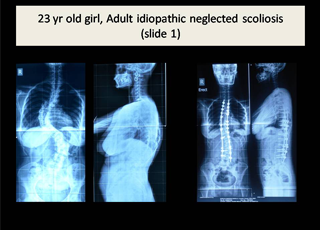
Adult - diagnosed in adulthood, after skeletal maturity has occurred
Most cases of scoliosis are mild, but some children develop spine deformities that continue to get more severe as they grow.
Signs and symptoms of scoliosis may include :
- Uneven shoulders
- One shoulder blade that appears more prominent than the other
- Uneven waist
- One hip higher than the other
- Back pain and breathing difficulty
One should consult a spine surgeon if you notice signs or symptoms of scoliosis in your child. Mild curves, however, can develop without the parent or child knowing it because they appear gradually and usually don't cause pain. Occasionally, teachers, friends and sports teammates may be the first to notice a child's scoliosis.
Causes
- Idiopathic – Though this is the most common type of scoliosis still the cause of this type of scoliosis is not definitely known.
- Neuromuscular conditions, such as cerebral palsy or muscular dystrophy
- Birth defects affecting the development of the bones of the spine
- Injuries to or infections of the spine
Risk factors
Risk factors for developing the most common type of scoliosis include:
Age. Usually the signs and symptoms begin during the growth spurt that is just before puberty. This occurs usually between the age of 9 and 15 years.
- Sex. Although both boys and girls develop mild scoliosis at about the same rate, it has been seen that girls have a much higher risk of the curve worsening and often requiring treatment.
- Family history. Most children with scoliosis don't have family history of the disease but it is known that Scoliosis can occur in families. Since scoliosis can run in families, a child who has a parent, brother, or sister with idiopathic scoliosis should be checked regularly for scoliosis by the family doctor.
Complications
While most people with scoliosis have a mild form of the disorder, scoliosis may sometimes cause complications, including:
- Lung and heart malfunctioning
- Back problems.
- Poor Cosmetic Appearance.
Tests and diagnosis
Medical history: This involves talking to the patient and the patient's parent(s) and reviewing the patient's records to look for medical problems that might be causing the spine to curve, for example, birth defects, trauma, or other disorders that can be associated with scoliosis.
- Physical examination. The doctor looks at the patient's back, chest, pelvis, legs, feet, and skin. The doctor checks if the patient's shoulders are level, whether the head is centered, and whether opposite sides of the body look level. The doctor also examines the back muscles while the patient is bending forward to see if one side of the rib cage is higher than the other. A neurological examination is done to check for, Muscle weakness, Numbness, Abnormal reflexes
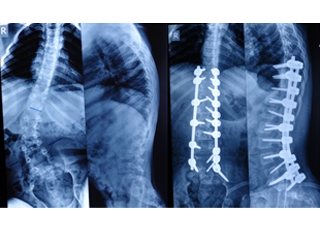
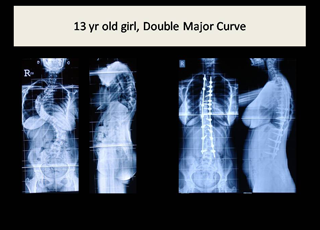
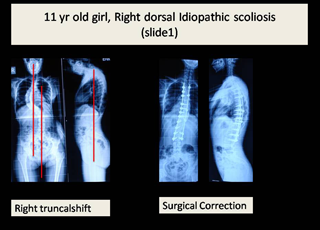
- X-ray evaluation. An x ray of the spine can confirm the diagnosis of scoliosis. The magnitude and type of scoliosis is measured on xray.
If an underlying condition is suspected— such as a tumor — is causing the scoliosis, additional imaging tests may be recommended, including:
- Magnetic resonance imaging (MRI).
- Computerized tomography (CT scan).
- Bone scan.
Treatments
Most children with scoliosis have mild curves and probably won't need treatment with a brace or surgery. Children who have mild scoliosis may need checkups every four to six months to see if there have been changes in the curvature of their spines.
While there are guidelines for mild, moderate and severe curves, the decision to begin treatment is always made on an individual basis. Factors to be considered include:
- Sex. Girls have a much higher risk of progression than do boys.
- Severity of curve. Larger curves are more likely to worsen with time.
- Curve pattern. Double curves, also known as S-shaped curves, tend to worsen more often than do C-shaped curves.
- Location of curve. Curves located in the center (thoracic) section of the spine worsen more often than do curves in the upper or lower sections of the spine.
- Maturity. If a child's bones have stopped growing, the risk of curve progression is low. That also means that braces have the most effect in children whose bones are still growing.
Observation
Doctors typically follow patients without treatment and re-examine them every few months when the patient is still growing and the curve is mild.
Spinal Braces
If the child's bones are still growing and he or she has moderate scoliosis, they may be recommended a brace. Wearing a brace won't cure scoliosis, or reverse the curve, but it may prevent further progression of the curve. Most braces are worn day and night. A brace's effectiveness increases with the number of hours a day it's worn. Children who wear braces can usually participate in most activities and have few restrictions. If necessary, kids can take off the brace to participate in sports or other physical activities.
Custom molded braces can be ordered through specialty medical suppliers with a prescription.
Braces are of two main types:
- Underarm or low-profile brace
- Milwaukee brace.
Surgery
Severe scoliosis typically progresses with time, so surgery is suggested to reduce the severity of the spinal curve and to prevent it from getting worse. The main surgical procedure is deformity correction i.e. scoliosis correction, spinal instrumentation, and spinal fusion of the curve.
Surgery is usually postponed until after a child's bones have stopped growing. If the scoliosis is progressing rapidly at a young age, surgeons can install a rod that can adjust in length as the child grows. This growing rod is attached to the top and bottom sections of the spinal curvature, and is usually lengthened every six months.
Minimally Invasive spine surgery (MISS) for scoliosis treatment
Recently there has been a surge in the number of scoliosis cases being treated by key hole surgery approach. There are certain forms of scoliosis that are particularly amenable to endoscopic correction, especially curves only involving the thoracic spine. Lumbar and thoracolumbar curves are better approached with a more traditional open technique.
Patients and parents who are thinking about surgery may want to ask the following questions:

- What are the benefits from surgery for scoliosis?
- What are the risks from surgery for scoliosis?
- What techniques will be used for the surgery?
- What devices will be used to keep the spine stable after surgery?
- Where will the incisions be made?
- How straight will the spine be after surgery?
- How long will the hospital stay be?
- How long will it take to recover from surgery?
- Is there chronic back pain after surgery for scoliosis?
- Will the patient's growth be limited?
- How flexible will the spine remain?
- Can the curve worsen or progress after surgery?
- Will additional surgery be likely?
- Will the patient be able to do all the things he or she wants to do following surgery?
Complications of spinal surgery may include bleeding, infection, pain or nerve damage. Rarely, the bone fails to heal and another surgery may be needed.
Others :
Some people have tried other ways to treat scoliosis, including manipulation by a chiropractor, massage, electrical stimulation, pilates, yoga, stretching and other therapies. They may provide symptomatic relief; however, studies of these treatments have not been shown to prevent curve progression, or worsening.
Exercise :
Although exercise programs have not been shown to affect the natural history of scoliosis, exercise is encouraged in patients with scoliosis to minimize any potential decrease in functional ability over time. It is very important for all people, including those with scoliosis, to exercise and remain physically fit. Girls have a higher risk than boys of developing osteoporosis (a disorder that results in weak bones that can break easily) later in life. The risk of osteoporosis can be reduced in women who exercise regularly all their lives. Also, weight-bearing exercise, such as walking, running, soccer, and gymnastics, can increase bone density and help to prevent osteoporosis. For boys and girls, exercising and participating in sports can also improve their general sense of well-being.
Ongoing research:
Researchers are exploring genetic and neurological factors that may cause idiopathic scoliosis in an effort to identify targets for prevention and new treatments. Researchers continue to examine how a variety of braces, surgical procedures, and surgical instruments can be used to straighten the spine or to prevent further curvature. They are also studying the long-term effects of both scoliosis fusion and the long-term effects of untreated scoliosis



 Get in Touch
 Obabuji.com