ACDF(Anterior cervical discectomy and fusion)
An anterior surgical approach involves operating from the front of the neck through a 1- to 2-inch incision along the neck crease. surgeon removes the problem disk. The area left over is stretched, so that the height is similar to what it was prior to the disk wearing out. A bone graft or cage and graft is placed in the space where the disk was removed.Removing a disk or vertebra requires stabilizing the spine through fusion. Spinal fusion is essentially a "welding" process. The basic idea is to fuse together spinal bones (vertebrae) so that they heal into a single, solid bone.Fusion will take away some spinal flexibility. The degree of limitation depends upon how many spine segments or "levels" are involved.In addition to fusion, metal plates and screws are commonly used to help keep the bones in place.
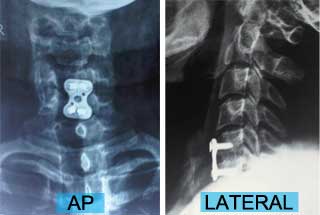 Indication:-
- Cervical radiculopathy
- Cervical spondylotic myelopathy (0ne to three level)
- OPLL
- Cervical canal stenosis
Advantages :-
- Good relief of neck pain
- Stabilized with fusion
- Restores alignment of spine
- Direct removal of problem structures
Disadvantages :-
- Approach/ graft complications
- Possible need for bracing
- Motion loss
Complication :-
The potential risks specific to anterior cervical spine surgery include:
- Misplaced, broken, or loosened plates and screws
- Soreness or difficulty with swallowing
- Voice changes
- Difficulty breathing
- Injury to the esophagus
- Degeneration of disk levels above or below the surgery level
- Fibrous union
- Graft related complications, including hip pain (if an autograft is used), dislodgement, fracture, or severe settling
- Nonunion of vertebral body fusion
General Risks:-
The potential risks for cervical spine surgery include :-
- Infection
- Bleeding
- Injury to the nerves
- Injury to the spinal cord
- Reactions to anesthesia
- Need for additional surgery in the future
- Failure to relieve symptoms
- Tear of the sac covering the nerves (dural tear)
Outcomes :-
The primary goal of surgery for CSM, regardless of approach, is to stabilize the spine and prevent neurologic problems from getting worse. The goal is not necessarily to restore normal function. A secondary goal is potentially improving the associated neck pain, motor (weakness), sensory (numbness/tingling), and gait (walking) disturbances.
Final outcomes from the surgery vary. Typically, one-third of patients improve, one-third stay the same, and one-third continue to worsen over time, with respect to their pre-surgical symptoms.
People with CSM are recommended for surgery to make sure that their symptoms do not get worse. In most cases, the symptoms they have going into the operating room are what they will have afterwards.



 Get in Touch
 Obabuji.com